You probably know whether your customers would recommend your business. But do you know whether your employees would recommend it as a place to work?
That’s the question at the heart of the employee net promoter score (eNPS), one of the simplest, most revealing metrics available to HR leaders today. It takes just seconds for employees to answer and gives organizations a clear, trackable signal of engagement, loyalty, and culture health.
Here’s everything you need to know to start measuring and improving yours.
What Is the Employee Net Promoter Score?
The employee net promoter score is a measurement tool that gauges how willing employees are to recommend their organization as a great place to work. It’s adapted from the Net Promoter Score (NPS) framework developed by Fred Reichheld at Bain & Company, originally designed to measure customer loyalty, and has become a widely adopted metric for assessing employee sentiment.
The entire survey hinges on a single question:
“On a scale of 0 to 10, how likely are you to recommend this company as a place to work to a friend or colleague?”
Based on their response, employees fall into one of three categories:
- Promoters (9–10): Highly engaged employees who actively advocate for your organization, both internally and in the talent market.
- Passives (7–8): Employees who are content but not deeply committed. They’re unlikely to promote your organization and may be open to other opportunities.
- Detractors (0–6): Disengaged or dissatisfied employees who are unlikely to recommend your organization and may even share negative feedback externally.
How to Calculate Employee Net Promoter Score
The eNPS formula is straightforward:
eNPS = % of Promoters − % of Detractors
Passives are excluded from the calculation, their neutral stance neither helps nor hurts the score.
Example: If 60% of your employees are Promoters and 15% are Detractors, your eNPS is +45.
Scores range from −100 (every employee is a Detractor) to +100 (every employee is a Promoter). Any positive score means you have more advocates than critics, which is a meaningful starting point.
What’s a Good eNPS Score?
Context matters when interpreting your score, industry, company size, and geography all shape what’s considered strong. That said, general benchmarks offer useful orientation:
- Below 0: More detractors than promoters. A signal to investigate and act quickly.
- 0–10: Acceptable, but limited advocacy.
- 10–30: Good, employees are more likely to recommend your organization than not.
- 30–50: Strong performance and meaningful employee satisfaction.
- Above 50: Excellent, reserved for organizations with deeply positive cultures.
According to QuestionPro’s 2025 eNPS benchmark data, the overall average across all industries reached 32, up from 25 in 2024. Industry scores vary considerably:
- Information Technology leads at 66,
- Financial Services sits at 46,
- Healthcare at 25, and
- Manufacturing at 21
Knowing where your industry lands helps set realistic targets.
One important note: the trend matters as much as the number. An eNPS of +15 that’s climbing is more meaningful than a +30 that’s declining.
Why eNPS Matters Beyond the Number
The employee net promoter score isn’t just a satisfaction metric, it’s a leading indicator of business performance.
Retention: Promoters are far less likely to leave. Given that voluntary turnover remains costly, with replacement costs ranging from 40% to 200% of an employee’s annual salary depending on the role, even a modest improvement in eNPS can translate to significant savings.
Engagement: Organizations with highly engaged workforces consistently outperform their peers. Gallup research finds that companies with high engagement levels report 21% higher profitability and 17% higher productivity. eNPS is one of the fastest ways to track whether your engagement initiatives are gaining traction.
Employer brand: Promoters don’t just stay, they recruit. When employees speak positively about their workplace to their networks, they become one of your most credible and cost-effective talent acquisition channels.
Culture feedback: Detractor and Passive responses, especially when paired with an open-ended follow-up question, surface friction points that leaders might not otherwise see.
How to Use eNPS to Improve Engagement and Retention
Measuring eNPS is only valuable if you act on it. Here’s how to translate scores into meaningful change.
Survey regularly. Annual eNPS surveys produce a snapshot that may already be outdated by the time you read it. Quarterly pulse surveys give you the trend data needed to connect culture initiatives to actual shifts in employee sentiment.
Always follow up with an open-ended question. Ask: “What’s the primary reason for your score?” The number tells you where you are; the qualitative feedback tells you why and what to do about it.
Close the loop publicly. According to Gallup’s 2025 State of the Global Workplace report, only a quarter of employees strongly agree that their organization acts on survey feedback. When leaders communicate what they heard and what they’re changing as a result, trust builds. When they don’t, survey fatigue sets in.
Segment your results. An organization-wide eNPS may mask significant variation by department, tenure, or location. Segmented data reveals where to focus improvement efforts first.
Invest in recognition. One of the most consistent drivers of higher eNPS is whether employees feel valued for their work. According to Gallup research, employees who receive high-quality recognition are 45% less likely to leave their jobs, and far more likely to become Promoters in the process. When recognition is woven into your culture rather than reserved for annual reviews, eNPS trends upward.
eNPS and Recognition: A Powerful Combination
Your eNPS score reflects how employees feel about working at your organization. Recognition programs directly shape those feelings.
When employees are consistently acknowledged for their contributions, through personalized rewards, milestone celebrations, peer-to-peer recognition, and values-based acknowledgment, they feel seen, appreciated, and connected to their workplace. Those are the conditions that turn Passives into Promoters and Detractors into employees who want to stay and grow.
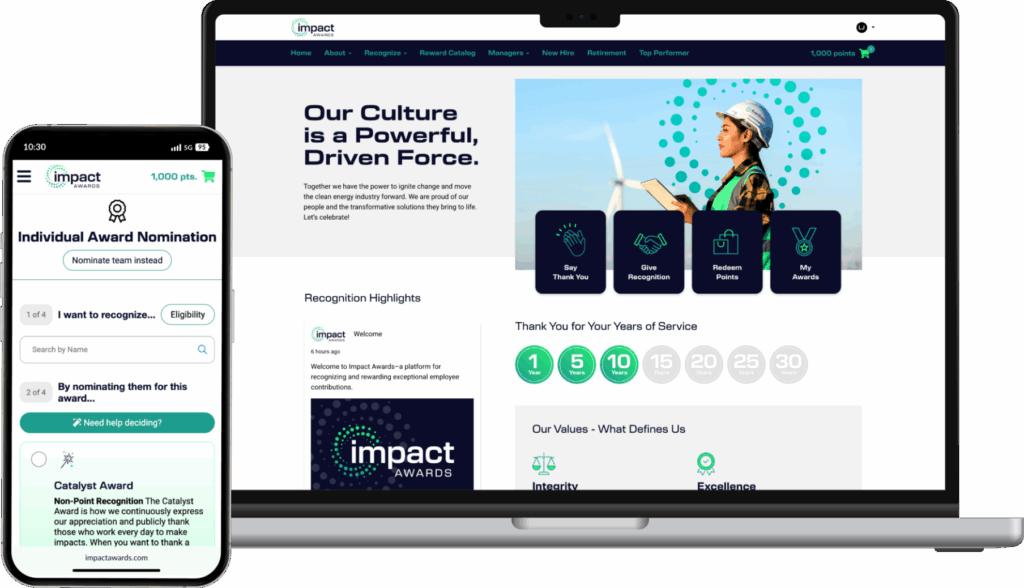
At Xceleration, we help organizations build strategic recognition programs that move the needle on the metrics that matter most, including eNPS. Our RewardStation platform gives HR leaders the tools to deliver meaningful, measurable recognition at scale, across every location, department, and level of the organization.
Start Measuring. Start Improving.
The employee net promoter score is one of the most efficient tools in an HR leader’s toolkit. It’s fast to deploy, easy to understand, and, when paired with consistent follow-through, powerful enough to drive real improvements in engagement, retention, and culture.
But a score without action is just a number. The organizations that see results are those that treat eNPS as a starting point for conversation, not a final verdict.
Sources: QuestionPro eNPS Industry Benchmarks (2025); Gallup, “The Human-Centered Workplace” (2024); Gallup State of the Global Workplace Report (2024); Bain & Company NPS methodology